
Cross 9
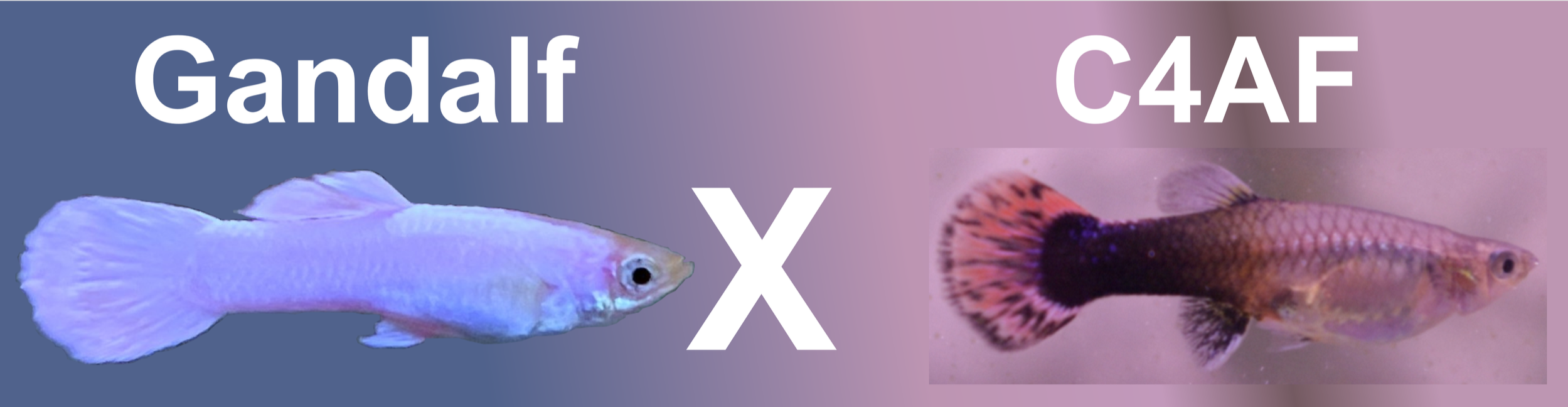
Purpose: Fifth backcross to restore the snow white phenotype.
Male (Gandalf):
Bought from a big box store during February 2023 as part of the initial stock.
Strain: Snow White
Relevant genes. Some are assumptions, indicated with italics. Although their decedents strongly support the claims:
Base body color: Blond (bb)
Magenta: likely homozygous (MM)
European Blau: (rr)
Stoerzbach: (ss)
Nigrocaudatus: (XⁿᶦᴵY)
Female (C4AF):
Gandalf’s daughters from Cross 4 (I used 2 total females).
Strain: Half Snow-White
Relevant genes. Some are assumptions, indicated with italics. Although their decedents strongly support the claims:
Base body color: Gray (Bb)
Magenta: likely a carrier (Mm)
European Blau: (Rr)
Stoerzbach: (Ss)
Nigrocaudatus: likely heterozygous (XᴺᶦᴵXⁿᶦᴵ)
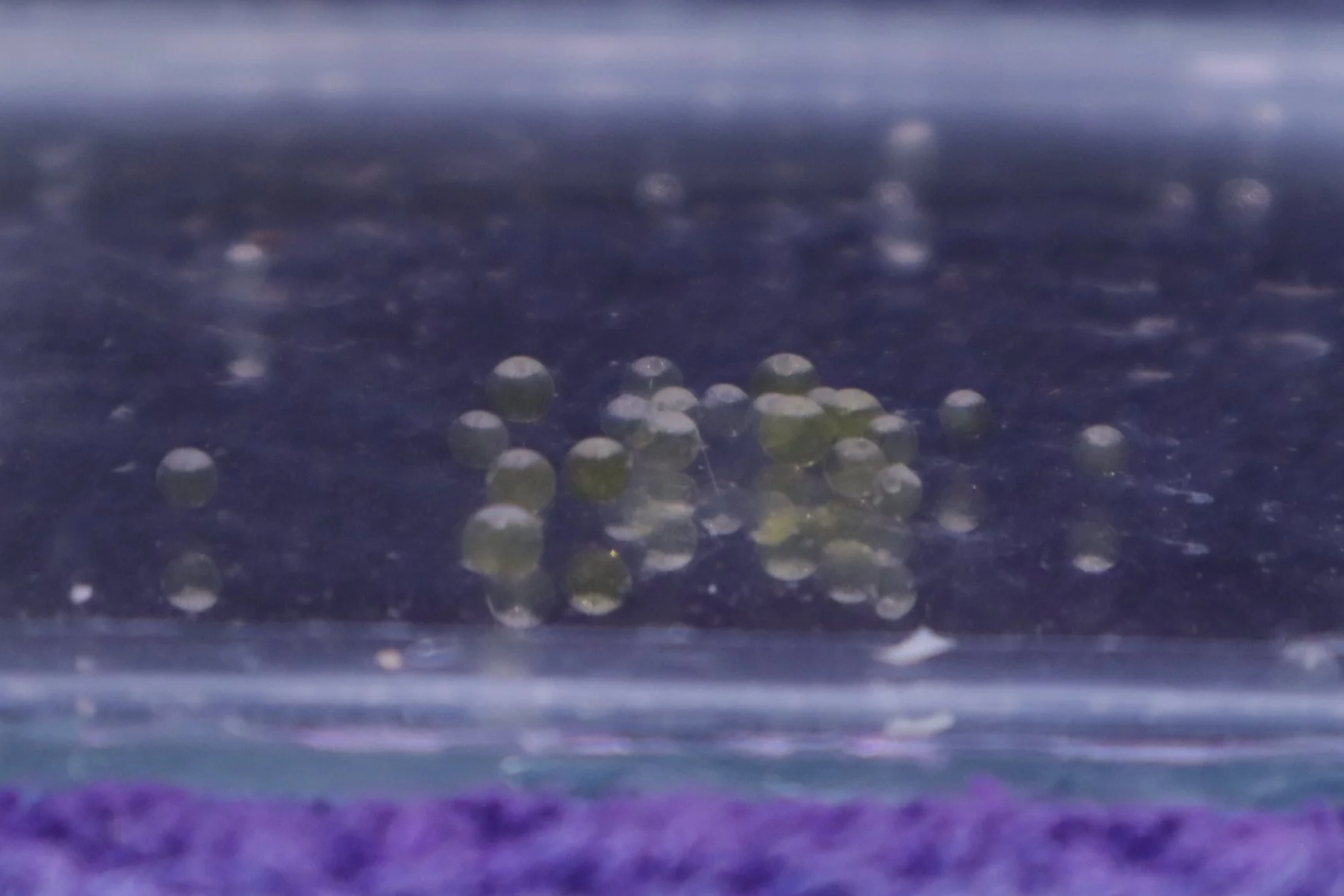
This cross took a significant amount of time to produce its first successful brood. For several months, both females appeared to drop only unfertilized eggs. While it’s possible that a small number of healthy fry were born during these initial drops and were immediately eaten, I suspect the majority were unfertilized. Although I originally paired Gandalf with the C4A females in February, it wasn't until June that I finally recorded a surviving brood.
Offspring:
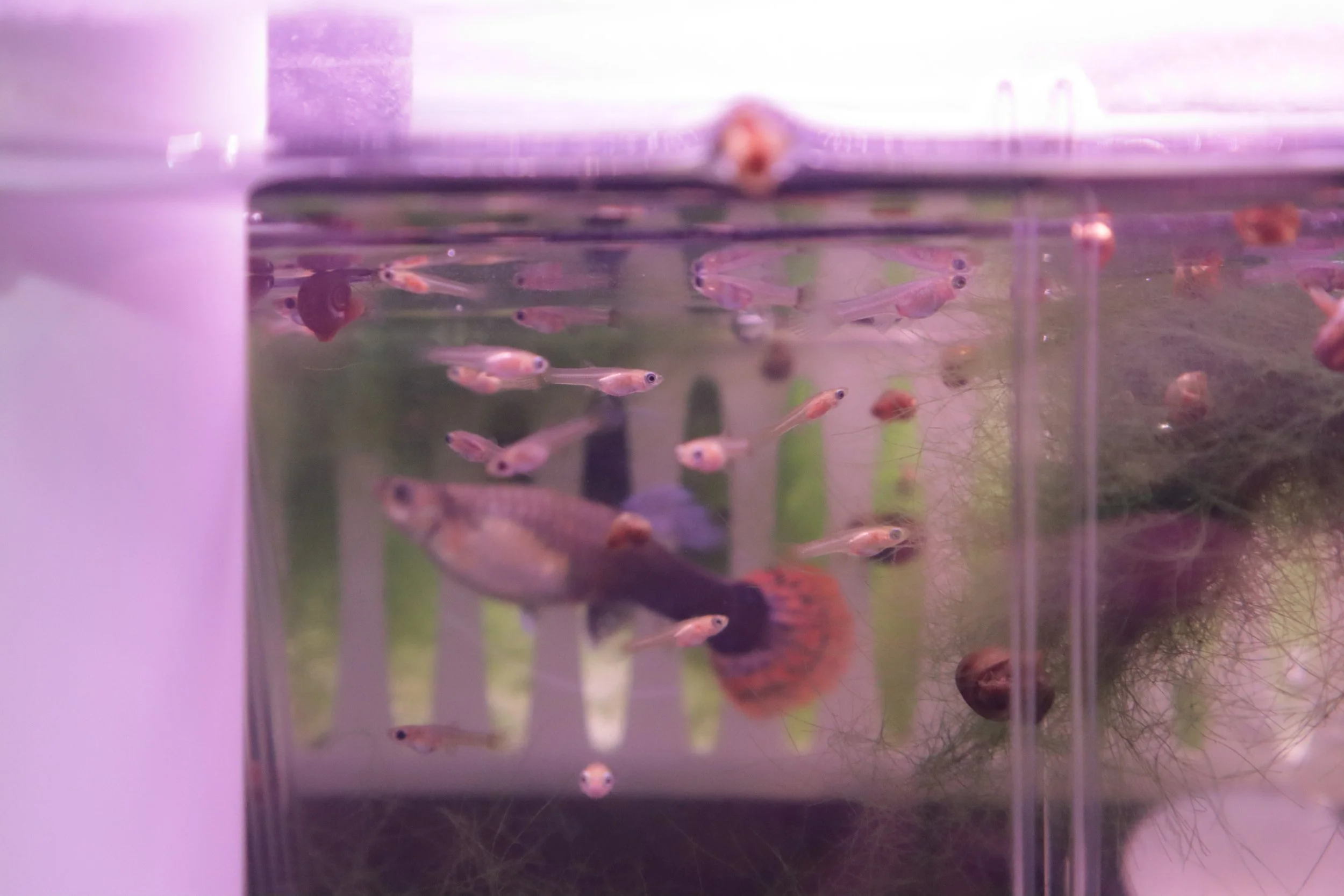
Born: June 3rd, June 23rd, and June 26th. Stopped recording after this.
Brood Size: 48
41 Male
7 Female
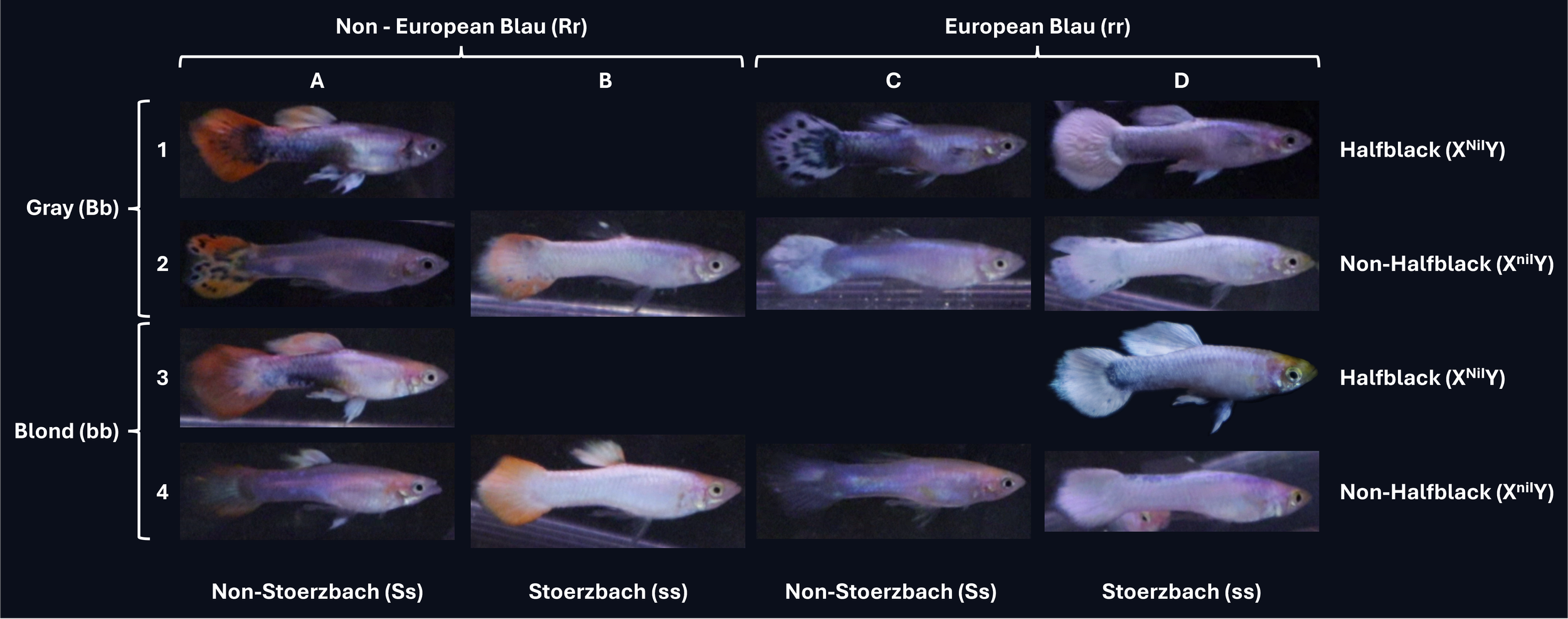
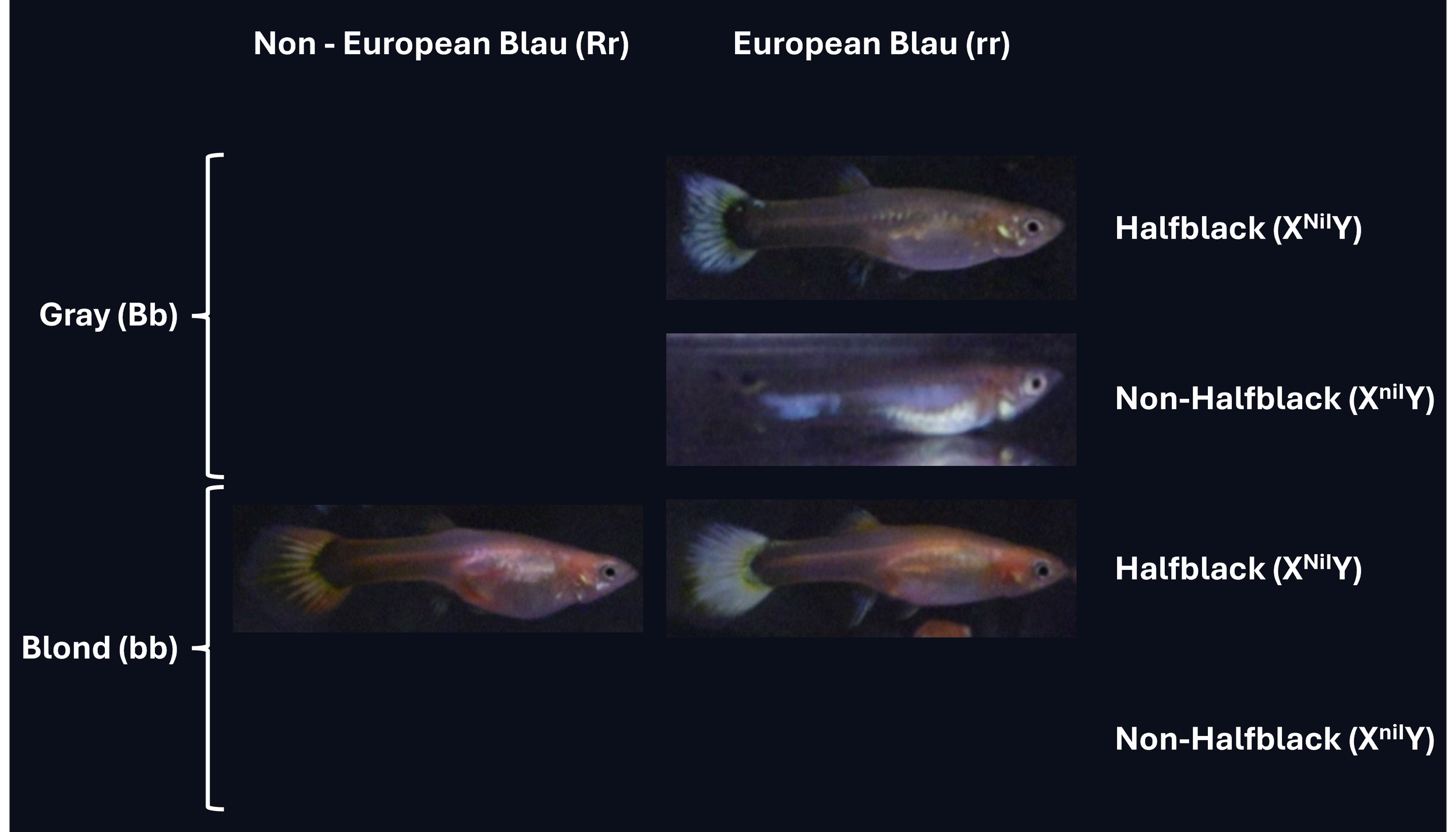
Offspring phenotypes and genotypes:
The figure above shows all the male phenotypes ordered by the relevant genes that showed an obvious phenotype. Base body color, European Blau, stoerzbach and Nigrocaudatus I (halfblack): I will use the grid as my grouping labels.
The females showed a similar phenotype distribution to the males, though Stoerzbach was much harder to distinguish in them. With only seven females in total, getting a statistically accurate representation was difficult. I also suspect I may have misidentified a few males as females early on. For instance, the gray, non-halfblack, European Blau "female" showed male traits but lacked a mature gonopodium. Reclassifying these late-blooming males would bring the total female count down even further.
Genotype distributions. Numbers indicate the distribution with-in just the males.
A1: Bb|(MM or Mm)|Rr|Ss|XᴺᶦᴵY, 5 males, 12.2%
B1: Bb|(MM or Mm)|Rr|ss|XᴺᶦᴵY, 0 males, 0%
C1: Bb|(MM or Mm)|rr|Ss|XᴺᶦᴵY, 4 males, 9.8%
D1: Bb|(MM or Mm)|rr|ss|XᴺᶦᴵY, 3 males, 7.3%
A2: Bb|(MM or Mm)|Rr|Ss|XⁿᶦᴵY, 4 males, 9.8%
B2: Bb|(MM or Mm)|Rr|ss|XⁿᶦᴵY, 1 male, 2.4%
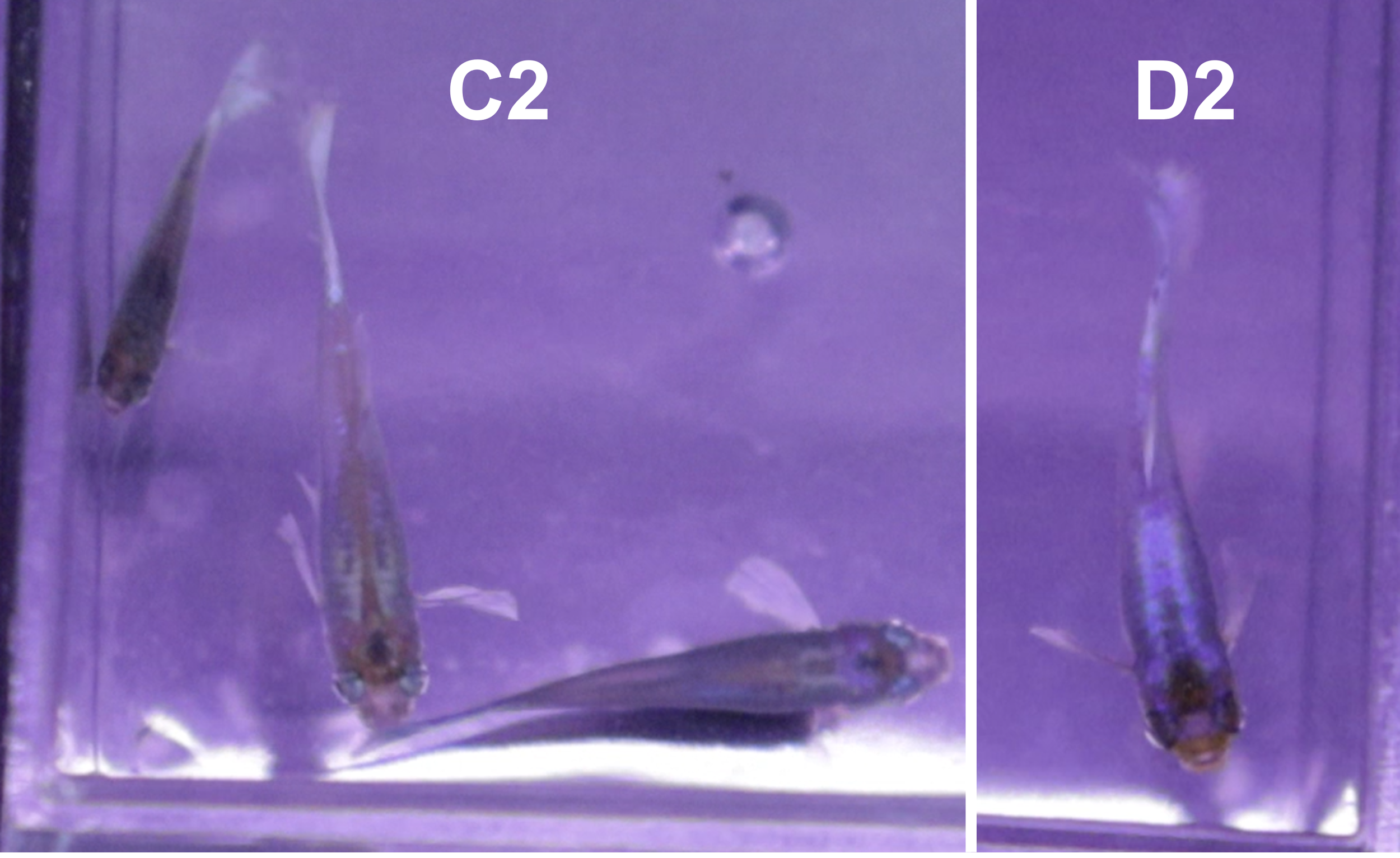
C2: Bb|(MM or Mm)|rr|Ss|XⁿᶦᴵY, 3 males, 7.3%
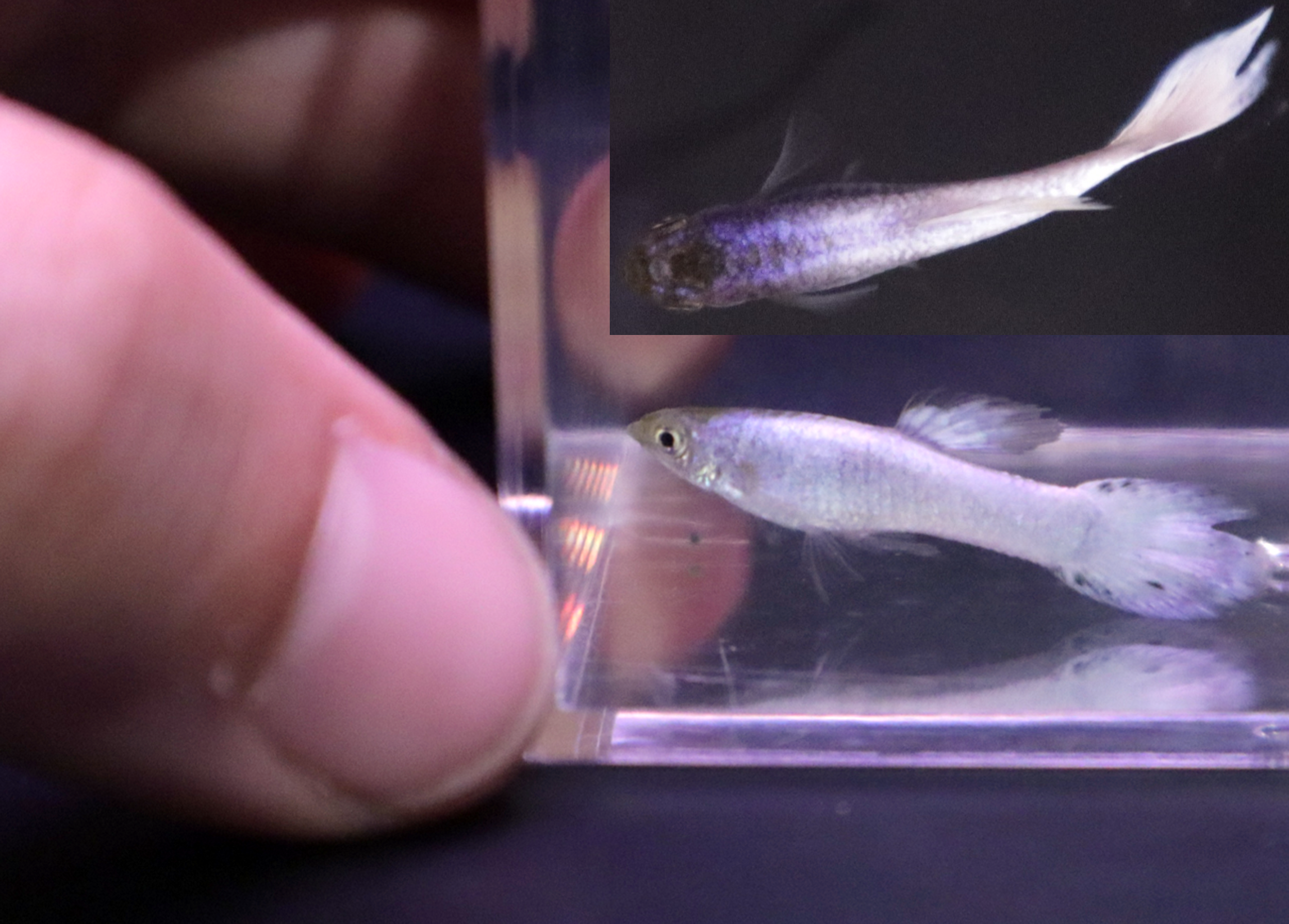
D2: Bb|(MM or Mm)|rr|ss|XⁿᶦᴵY, 1 male, 2.4%
A3: bb|(MM or Mm)|Rr|Ss|XᴺᶦᴵY, 3 males, 7.3%
B3: bb|(MM or Mm)|Rr|ss|XᴺᶦᴵY, 0 males, 0%
C3: bb|(MM or Mm)|rr|Ss|XᴺᶦᴵY, 0 males, 0%
D3: bb|(MM or Mm)|rr|ss|XᴺᶦᴵY, 2 males, 4.9%
A4: bb|(MM or Mm)|Rr|Ss|XⁿᶦᴵY, 2 males, 4.9%
B4: bb|(MM or Mm)|Rr|ss|XⁿᶦᴵY, 3 males, 7.3%
C4: bb|(MM or Mm)|rr|Ss|XⁿᶦᴵY, 8 males, 19.5%
D4: bb|(MM or Mm)|rr|ss|XⁿᶦᴵY, 2 males, 4.9%
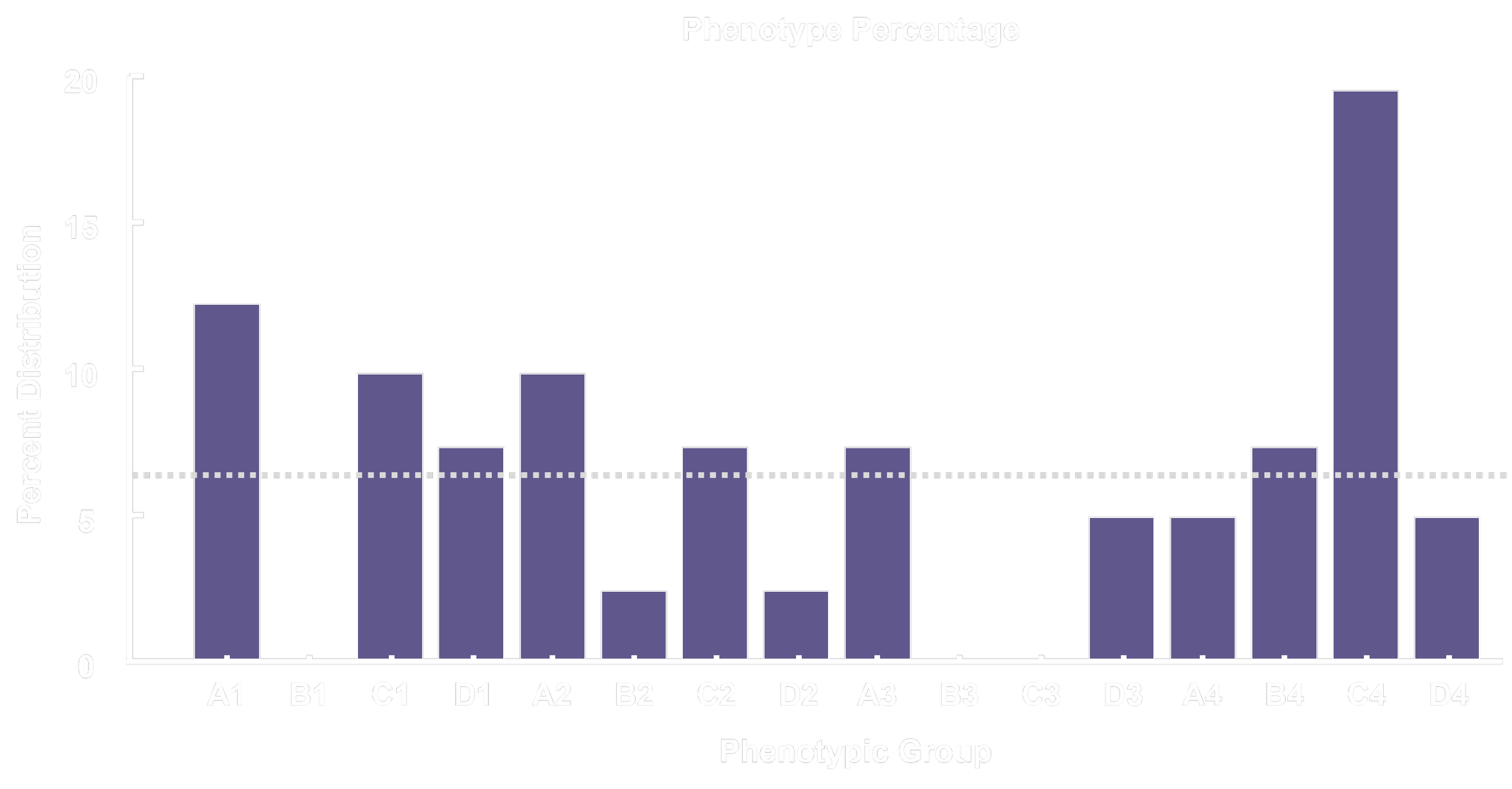
My expectation was that each of the 16 unique phenotypic combinations (resulting from four genes) would represent roughly 6.25% (indicated by the dotted line) of the offspring. This is because the C4A female is heterozygous for each gene, while Gandalf is homozygous. This means each individual gene should show an even 50% distribution of its two phenotypes. At first glance, the overall phenotypic distribution seems uneven with C4 having a majority. But a few of the phenotypes are close to the 6.25% line. However, after examining the distributions of each gene individually, the picture becomes much clearer:
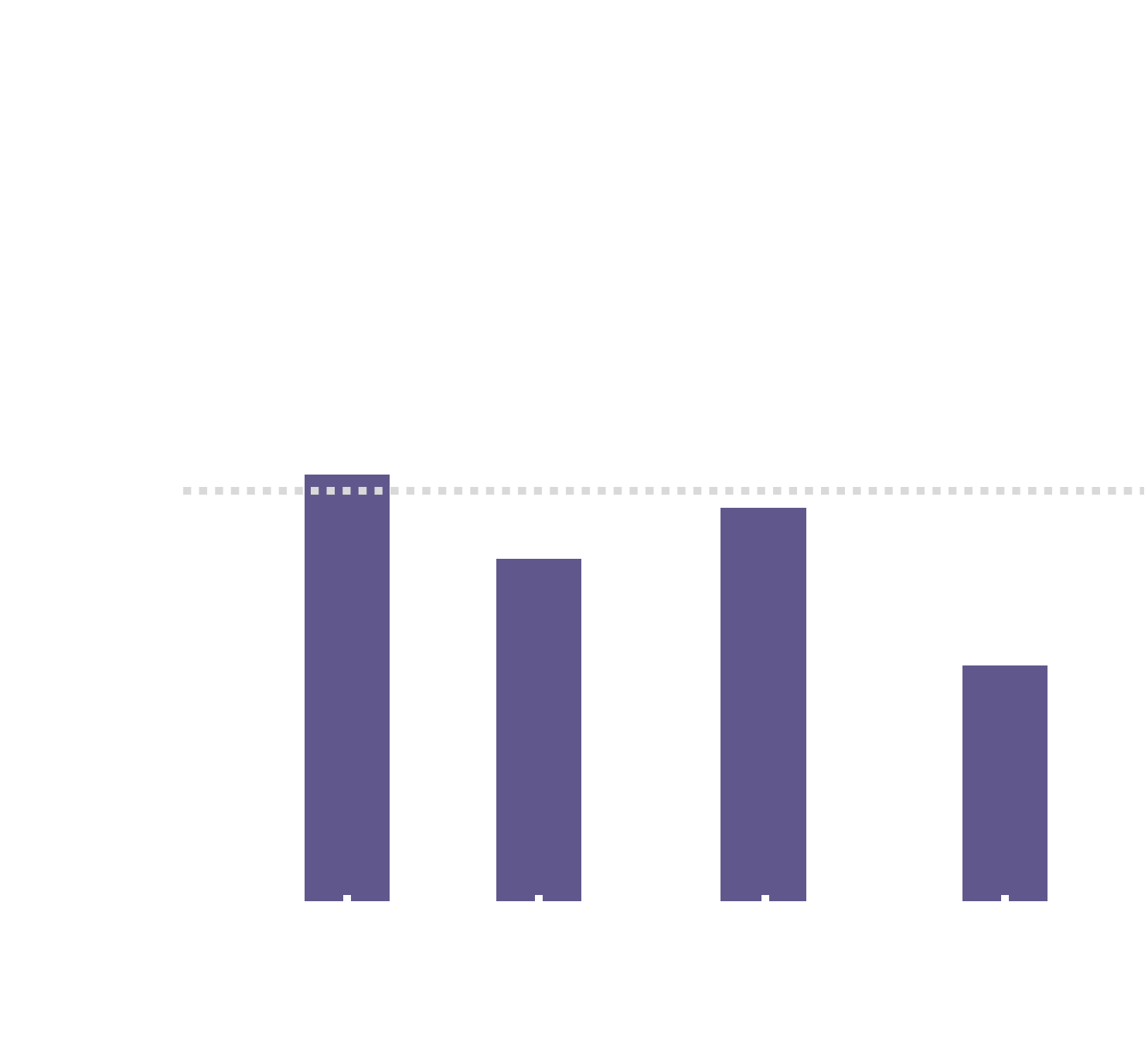
Base Body Bolor: 25 Blond : 23 Gray (Both males and females)
European Blau (EB): 20 EB : 28 Non-EB (Both males and females)
Halfblack: 23 Halfblack : 25 Non-Halfblack (Both males and females)
Stoerzbach: 12 Stoerzbach : 29 Non-Stoerzbach (These values reflect males only)
As anticipated, for genes where C4A is heterozygous and Gandalf is homozygous, we expected a near 50% split between the two phenotypes. And as you can see, the individual gene distributions align remarkably well with this expectation! The exception is of course stoerzbach. This is likely because it was rather difficult for me to truly identify between stoerzbach and non-stoerzbach and I ended up relying mostly on higher iridescence levels on the guppies back. Look at the example below between males C2 vs D2.
Notes:
I intentionally didn't focus heavily on magenta gene expression in this cross. The variety of phenotypes already present was extensive, and adding magenta to the analysis would have introduced significant complexity. However, given that magenta is incompletely dominant and Gandalf is likely homozygous (MM) for the gene, all offspring would inherit at least one magenta allele. C4AF, being Gandalf's daughter, is likely heterozygous (Mm) since her mother from Cross 4 (Female #4) probably lacked the magenta gene. Therefore, all offspring in this brood are either MM or Mm. Based on color alone, these phenotypes should be largely indistinguishable. Fin size, however, is a different matter. Magenta is thought to reduce fin size. I believe this largely occurs in its homozygous state, which aligns with its incomplete dominance. While I didn't collect specific fin size data for this brood, I do recall observing both long-finned and short-finned males. Without precise data, a proper distribution analysis isn't possible at this time.
The halfblack trait exhibited a 48% distribution in both males and females in this brood, which provides strong evidence for X-linkage. This indicates that the C4A female was indeed heterozygous for the halfblack gene. As a result, all halfblack female offspring produced here are also heterozygous. This suggests that if you breed any halfblack male offspring from this group, all their female progeny are expected to display the halfblack trait, though this hypothesis requires further testing.
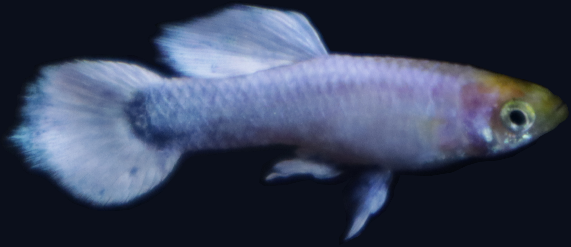
I was not satisfied with the overall snow white distribution in this cross so it was difficult to select the next breeders. I almost didn’t continue with this cross but ultimatly decided to continue with a halfblack snow white male due to his great finnage despite him carrying the halfblack trait. He was paired with a female from Cross 11 to form Cross 16. I labeled this male as Cross 9 Male A (C9AM).
A YouTube video detailing the start of Cross 9 can be found here.
C9AM
Gray-Based Snow White (D2)